

How Pakistan to Nottingham Cargo Services Work for Overseas Senders
Moving goods 4,000 miles from Pakistan to the East Midlands sounds daunting, but the supply chain is surprisingly well-trodden. Whether you are sending wedding suits to family in Hyson Green or importing commercial textile samples, booking reliable Pakistan to Nottingham cargo comes down to understanding the handoffs between origin hubs and your local UK delivery driver.
The biggest initial pitfall is picking the wrong operator. Large commercial freight forwarders excel at multi-container bulk freight, but they will leave you buried in customs paperwork if you only have three cartons. For non-containerized personal effects and smaller commercial parcels, dedicated courier networks are better; they handle clearance internally and bundle final-mile UK transit.
Regardless of who you book with, the route follows a set journey:
- Origin pickup & consolidation: Goods pool at major export facilities in Karachi, Lahore, or Islamabad/Rawalpindi.
- International transit to port of entry: Air freight lands predominantly at Heathrow or Birmingham; sea containers dock at southern ports like Felixstowe or Southampton.
- Regional dispatch: After HMRC clears the manifest, cargo transfers via the M1 corridor directly into Nottingham distribution centers for local delivery across NG1 through NG16 postcodes.
You will also need to decide how hands-on you want to be. Door-to-door services cost more upfront but save you from arranging UK haulage. Conversely, choosing depot drop-off or port collection means cheaper freight rates, but you will need your own van to collect the crates from Birmingham or London hubs—a costly hassle if you aren’t already set up for freight handling.
Here is what to expect regarding speed and transit methods:
| Service Type | Typical Transit Window | Best Suited For | Key Trade-Off |
|---|---|---|---|
| Expedited Air Cargo | 5–8 business days | Urgent packages, perishables, wedding wear | High cost per kilo; strict volumetric weight limits |
| Standard Sea Freight | 4–7 weeks | Household relocations, heavy inventory, non-perishables | Slower clearance; port congestion delays |
Next, let’s look at pricing structures, customs duties, and how to pack fragile items securely for the journey.
Air Freight vs Sea Freight: Choosing the Best Option for Nottingham Deliveries
Picking between air and sea transit comes down to two variables: your delivery deadline and how much space your goods consume.
When booking Pakistan to Nottingham cargo, air freight is the default choice for time-sensitive personal effects. We routinely see this route used for bespoke wedding wear from Lahore, original legal paperwork, and small cartons of non-perishable spices or dry foods. Shipments usually land at London Heathrow (LHR) before being trucked up the M1 to Nottingham, though direct belly-hold space into East Midlands Airport (EMA) is occasionally available through cargo charters. Transit via air generally wraps up in 5 to 8 days, door-to-door.
However, air freight carries a common pricing trap: volumetric weight. Airlines charge based on whichever is higher between the actual gross weight and the dimensional weight (calculated as Length × Width × Height in cm ÷ 5000). If you are flying a heavily padded bridal lehenga that weighs 8 kg but sits inside an oversized 22 kg-volume box, you pay for the 22 kg.
For full house moves, heavy commercial stock, or workshop machinery, ocean freight from Karachi Port is far more sensible. You will choose between two setups:
- LCL (Less than Container Load): Your cargo shares container space with other shippers. Best for loads between 2 and 12 cubic meters.
- FCL (Full Container Load): You hire a dedicated 20ft or 40ft steel box. Ideal for high-volume commercial runs or entire household relocations heading into Nottinghamshire.
The trade-off is time. Ocean freight typically takes 35 to 50 days to clear ports like Felixstowe or Southampton and reach your door.
| Cargo Profile | Best Route | Typical Transit | Break-Even Guideline |
|---|---|---|---|
| Under 100 kg (dense goods) | Air Cargo (via LHR/EMA) | 5–8 days | Fast turnaround justifies higher rate |
| Volumetric/Light (e.g., textiles) | Air Cargo | 5–8 days | Billable weight often exceeds physical weight |
| 100 kg to 500 kg | LCL Sea Freight | 35–45 days | Ocean becomes significantly cheaper per kg |
| Over 15 CBM / Full House | FCL Sea Freight | 40–50 days | Lowest cost per unit, maximum security |
As an operational rule of thumb, once your consignment crosses roughly 100 to 120 kilograms of billable weight, sea freight costs plummet compared to air—provided you can afford the month-long wait on the water.
 UK Customs Regulations and Duty Calculations on Goods from Pakistan
 UK Customs Regulations and Duty Calculations on Goods from Pakistan
Clearing UK customs isn’t just about paying taxes; it is about proving what your shipment actually contains before Border Force flags it. When moving Pakistan to Nottingham cargo, whether you land at East Midlands Airport or clear through Felixstowe before regional distribution, your tax liability hinges entirely on intent and classification.
For commercial freight, HM Revenue & Customs (HMRC) assesses duty based on the UK Global Tariff commodity code, followed by the standard 20% VAT. VAT applies not just to the inventory cost, but to the full landed cost—goods, freight, and marine insurance combined.
If you are moving your household permanently, never pay these fees. Apply for Transfer of Residence (ToR1) relief through HMRC well before your freight departs Karachi or Lahore. Once approved, your unique ToR number lets you import used personal effects duty- and tax-free, provided you have owned them for at least six months.
| Cargo Intent | Typical UK Duty | Standard VAT | Key Prerequisite |
|---|---|---|---|
| Commercial Stock | 0% to 12%+ (HS code dependent) | 20% on CIF value | GB EORI number & full commercial invoice |
| Relocation (Personal) | Zero (with ToR1) | Zero (with ToR1) | Approved HMRC ToR1 reference number |
| Low-Value Samples | Generally zero under £135 | 20% point-of-sale/entry | Clear proof of B2B sample status |
Border Force scrutinises freight from South Asia for specific non-compliant items. A single misdeclared product can freeze an entire consolidation pallet:
- Restricted agri-goods: Raw seeds, soil, and unpasteurised edible products face instant confiscation under sanitary and phytosanitary rules.
- Uncertified herbal remedies: Loose desi health treatments or unlabelled Unani medicines will lead to physical inspections and destruction notices from the MHRA.
- Branded textiles: Unlicensed designer replicas purchased from wholesale markets in Faisalabad or Lahore run afoul of intellectual property laws, risking heavy fines alongside cargo seizure.
To protect your delivery timeline, prepare an unambiguous Commercial Invoice and Packing List. Avoid vague descriptions like “household goods” or “cotton fabric samples.” Detail the exact unit counts, material compositions, net weights, and clear currency declarations (GBP or USD). Border officials routinely audit undervaluation; declare realistic replacement values up front to keep your goods rolling straight into Nottinghamshire without terminal storage penalties.
Professional Packing Standards to Prevent Transit Damage on Long-Haul Routes
Moving freight across continents isn’t just about putting items in a box and hoping for the best. With cargo traveling from dry Punjabi heat or humid Karachi port air to a drizzly Midlands depot, packaging failure is the number one reason shipments arrive damaged. If you want your Pakistan to Nottingham cargo to clear handling hubs intact, your packing prep needs to be industrial-grade.
Standard single-wall cartons won’t survive the journey. Always opt for five-ply, double-walled corrugated boxes with an interior moisture-barrier lining—like polyethylene sheeting—to block ocean condensation. Seal seams using cross-weave fiberglass strapping tape rather than standard clear vinyl, which tends to peel when temperatures fluctuate.
Different commodities demand distinct handling protocols before they ever touch a pallet:
| Item Type | Vulnerability | Packing Standard |
|---|---|---|
| Bridal Lehengas & Sherwanis | Tarnish, snagging, damp | Acid-free tissue paper wrap inside vacuum-sealed bags; never fold over heavy zardozi work |
| Brassware & Metal Crafts | Scratching, weight-crush | Individual bubble pouches, separated by rigid corrugated dividers |
| Glass Inlay & Ceramics | Impact shock, vibration | Double-boxing with 50mm of dense foam fill between the inner and outer cartons |
If you’re using consolidated sea freight (LCL), UK distribution centers won’t accept loose cargo off the truck. Your boxes must be consolidated onto heat-treated, ISPM-15-certified wooden pallets. Stack the heaviest cartons at the base, keep the profile square without overhang, and apply at least five layers of high-gauge shrink wrap, anchoring the film directly to the pallet base.
Finally, do not rely on standard paper waybills glued to cardboard. Multimodal transfers between trucks, feeder vessels, and rail yards will scuff them off. Use waterproof laser-printed labels enclosed in clear pouches on two opposing sides of every pallet, paired with numbered, tamper-evident security tape. If a customs officer or handler cuts into your box along the way, that broken seal gives you immediate, visual proof of where liability lies.
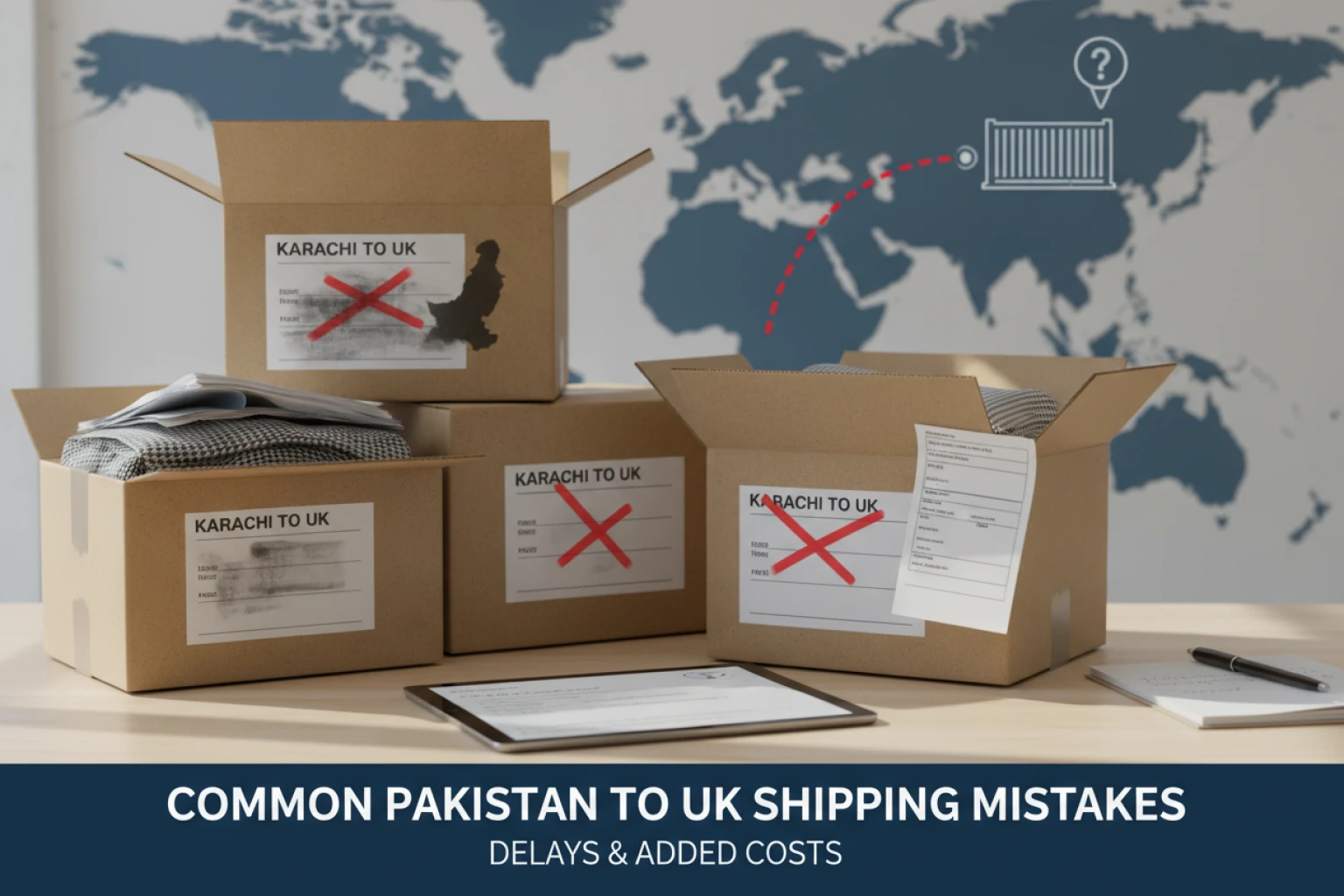
Common Pakistan to UK Shipping Mistakes That Cause Delays and Added Costs
Moving goods across borders always comes with friction, but moving Pakistan to Nottingham cargo without a clear grasp of UK import mechanics is an expensive gamble. Most supply chain bottlenecks do not happen mid-air or out at sea; they happen on paper before the goods ever clear Felixstowe, Southampton, or Heathrow.
A classic mistake we see shippers make is artificially slashing invoice values on commercial manifests to save on import VAT. HMRC flags undervalued goods constantly. Once an audit trigger hits, your shipment sits in customs storage racking up daily rent while border officials demand original bank transfer receipts and manufacturer price lists. You risk outright seizure, compounding penalty fees, and weeks of dead time.
Delivery errors on the UK mainland cause a different kind of headache. Shippers often put down a Pakistan phone number or skip the precise postal code. Local couriers servicing Nottingham—whether navigating narrow streets in the Lace Market or running residential drops in Hyson Green—require a working UK mobile to coordinate access codes and timed slots. Without it, your freight gets marked as a failed drop and heads straight back to a regional sorting depot.
Pricing surprises also hit hard on the sea route. Budget ocean quotes look tempting until the vessel berths.
| Hidden Sea Freight Surcharge | When It Triggers | Practical Impact on Nottingham Shipments |
|---|---|---|
| Terminal Handling Charges (THC) | Payable at the UK destination port | Unbudgeted cash required before container release. |
| Port Demurrage | Exceeding standard free time (usually 3–5 days) | Hundreds of pounds in fees before inland trucking starts. |
Finally, never rely on a carrier’s standard terms for high-value merchandise like luxury textiles, brass handicrafts, or commercial equipment. Standard maritime and air conventions (like Hague-Visby or Montreal) pay by gross weight, not item worth. If 40 kilos of expensive bridal wear goes missing, statutory compensation amounts to pocket change. Secure dedicated, all-risk marine cargo insurance before the container doors close in Karachi or Lahore.
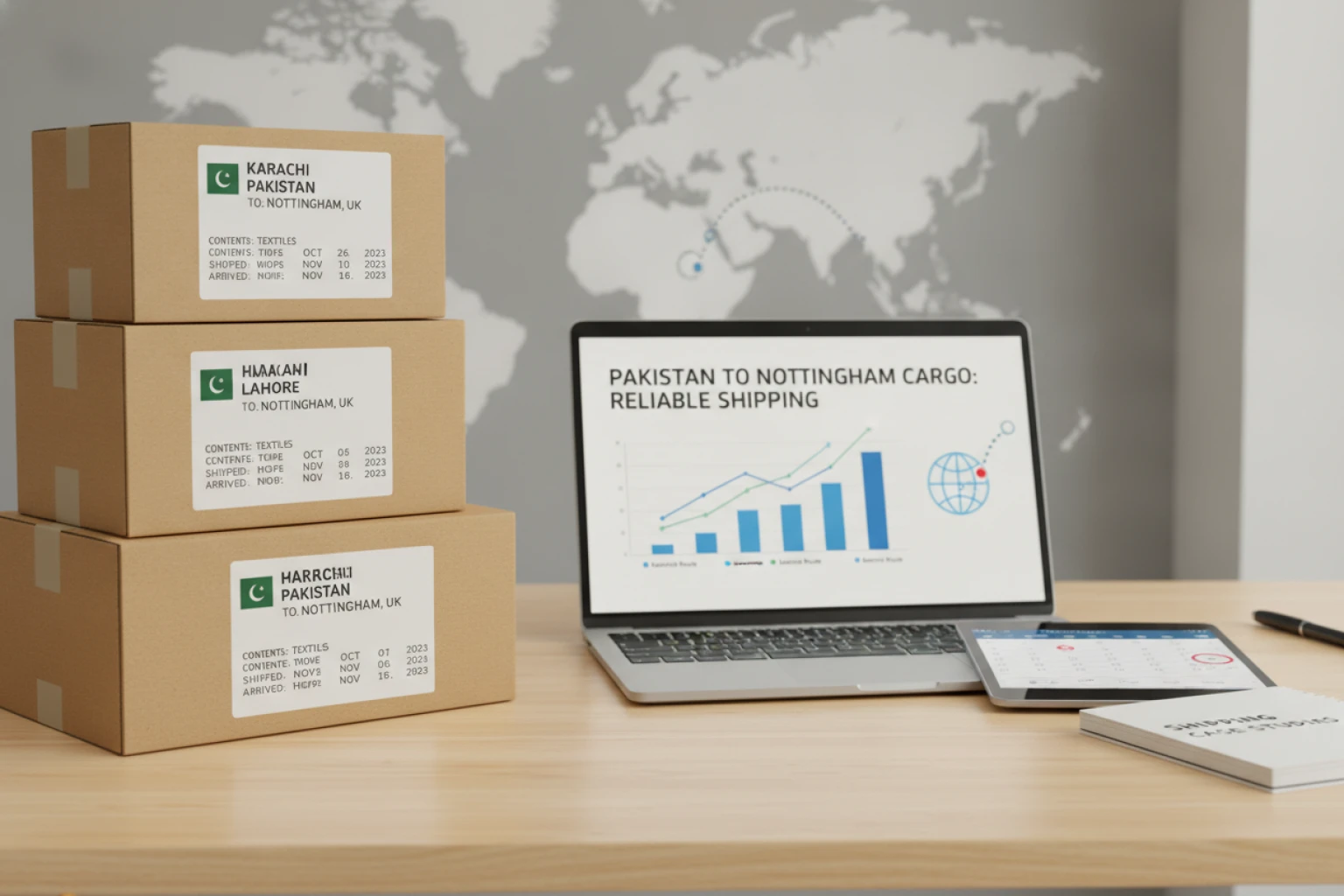
Real-World Shipping Timelines: Karachi and Lahore to Nottingham Case Studies
Paper transit estimates rarely match boots-on-the-ground reality. Customs delays, missing export paperwork, and Midlands regional distribution hubs can easily add days to your route. Here is how two real-world freight profiles move along the corridor.
Case 1: Urgent Bridal Wear via Air (Lahore to Beeston)
A bridal boutique needed a 45kg consignment of heavily embellished wedding wear moved from Lahore (LHE) to a residential studio in Beeston, Nottingham. Because silk and hand-embroidery face tight valuation checks, the sender pre-filed commercial invoices with precise fabric composition breakdowns.
- Day 1: Workshop collection in Gulberg, Lahore; moved to Allama Iqbal International cargo shed.
- Day 2–3: Export customs clearance and uplift via a Gulf carrier connection.
- Day 4: Wheels down at Birmingham Airport (BHX); entered UK bonded clearance.
- Day 5: Duty and VAT payment cleared through HMRC; transfer to regional depot.
- Day 6: Final-mile delivery to the doorstep in Beeston via tail-lift courier van.
Case 2: Sports Goods via Ocean LCL (Sialkot/Karachi to NG7)
A Nottingham fitness retailer imported 300kg of leather boxing gloves from Sialkot. Rather than paying air freight margins, they opted for sea freight, routing cargo through Karachi Port (KHI) to an e-commerce unit in Radford (NG7).
| Shipment Stage | Air Express (Case 1) | Sea LCL (Case 2) |
|---|---|---|
| Origin Handling & Export Customs | 48 hrs (Lahore) | 5 days (Sialkot bonded truck to KHI) |
| Main International Transit | 18 hrs flight + layover | 24 days water transit to Felixstowe |
| UK Port/Airport Clearance | 24 hrs (BHX bonded) | 4 days (Devanning & de-consolidation) |
| Final Delivery to Nottingham | Next-day regional van | 48 hrs via haulage pallet network |
| Total Turnaround | 6 business days | 35 calendar days |
Avoiding Seasonal Bottlenecks
Moving Pakistan to Nottingham cargo during the pre-Eid textile rush or the UK’s pre-Christmas retail surge requires different math. Booking sea freight less than six weeks before Christmas almost guarantees your container gets rolled at Port Qasim. For air freight ahead of Eid, cargo space out of Lahore fills instantly; if your paperwork has even minor discrepancies in weight declarations, your pallets sit on the tarmac while freight rates spike daily. Lock your carrier allocations early, and never cut import documentation margins close during peak quarters.

How to Select and Verify a Trustworthy Cargo Provider for Nottingham Delivery
Entrusting your goods to an overseas freight handler isn’t just about finding the lowest rate per kilo; it’s about making sure your boxes actually show up in Hyson Green or West Bridgford in one piece. If you pick the wrong forwarder, cheap transit quickly turns into held-up stock, surprise import tariffs, or worse, vanished freight.
Start by verifying their physical footprint and industry accreditations. A legitimate UK-based forwarder managing Pakistan to Nottingham cargo should have a verifiable Companies House registration, a real commercial depot—not just a residential semi—and active industry memberships such as the British International Freight Association (BIFA) or FIATA. These affiliations matter because member firms operate under standard trading conditions that legally define liability.
You should also look closely at how the forwarder tracks consignments. Many budget outfits promise “online tracking,” but there is a world of difference between actual visibility and vague status placeholders.
| Tracking Type | How It Operates | Real-World Value |
|---|---|---|
| Static Batch Scanning | Manual check-ins at major hubs (e.g., “Departed Lahore,” “Arrived UK”). | Cheap, but leaves days-long blind spots during customs handoffs. |
| Milestone Event GPS | Real-time scan updates paired with telematics on line-haul and local transit. | Essential for time-sensitive cargo; instantly alerts you to customs delays at East Midlands or Heathrow. |
Watch out for rogue door-to-door agents operating out of WhatsApp groups. Two immediate red flags: demanding cash-only handovers on collection in Pakistan, and dodging the paperwork. If an agent will not hand over a formal Air Waybill (AWB) or Bill of Lading alongside a written receipt, walk away. Without that document, you have zero legal ownership proof once the shipment leaves your sight.
Before handing over your cartons, run through this final booking checklist:
- Get an all-inclusive quote: Ensure clearance handling, UK terminal fees, and the final Nottingham drop-off are written down, not left as “to be calculated on arrival.”
- Confirm the final carrier: Ask plainly: who handles the final leg from the UK bonded warehouse to your Nottingham postcode?
- Verify claims liability: Know their payout limit per kilogram if transit damage occurs.
FAQS
How long does freight typically take from major Pakistani hubs to Nottingham?
Transit times hinge almost entirely on whether your boxes fly out of Lahore (LHE), Karachi (KHI), or Islamabad (ISB), or sail from Port Qasim. Air consignments usually land at East Midlands Airport (EMA) or Heathrow within five to eight working days, clear customs, and reach Nottingham doorsteps the following day. Ocean freight requires patience—plan for six to eight weeks minimum.
Transit Mode Typical Door-to-Door Window Best Suited For Air Express 4–7 business days Urgent documents, wedding wear, samples Standard Air Freight 8–12 business days Mid-weight cartons, commercial inventory Sea Cargo (LCL) 6–9 weeks Heavy household goods, bulky trade items Why do parcels get stuck in UK customs?
Border Force delays rarely happen by accident. In most cases, a shipper in Gujranwala or Sialkot filled out a generic commercial invoice listing items as simply “gifts” or “used clothes” without itemized values. When booking Pakistan to Nottingham cargo, HMRC requires precise descriptions.
Watch out for these routine customs tripwires:
- Undeclared food items: Homemade panjeeri, fresh fruit, or untinned dairy will get your entire consignment confiscated or destroyed.
- Vague valuations: Writing “value £10” on three heavy cartons of stitched bridal wear immediately triggers manual inspection and reassessment.
- Missing contact details: If the clearance agent cannot reach the Nottingham recipient for duty payment via phone or email, the freight sits in bonded storage racking up daily fees.
Can I pack my own boxes to save money?
You can, but don’t cut corners on materials. Standard single-wall grocery boxes collapse under the humidity changes between Karachi’s ports and UK sorting depots. Use double-wall corrugated boxes, seal every seam with reinforced tape, and shrink-wrap the exterior to protect against rain during transit transfers across the East Midlands.
Get a free quote today on WhatsApp: 0300-9535077 or visit our contact page.
 .