

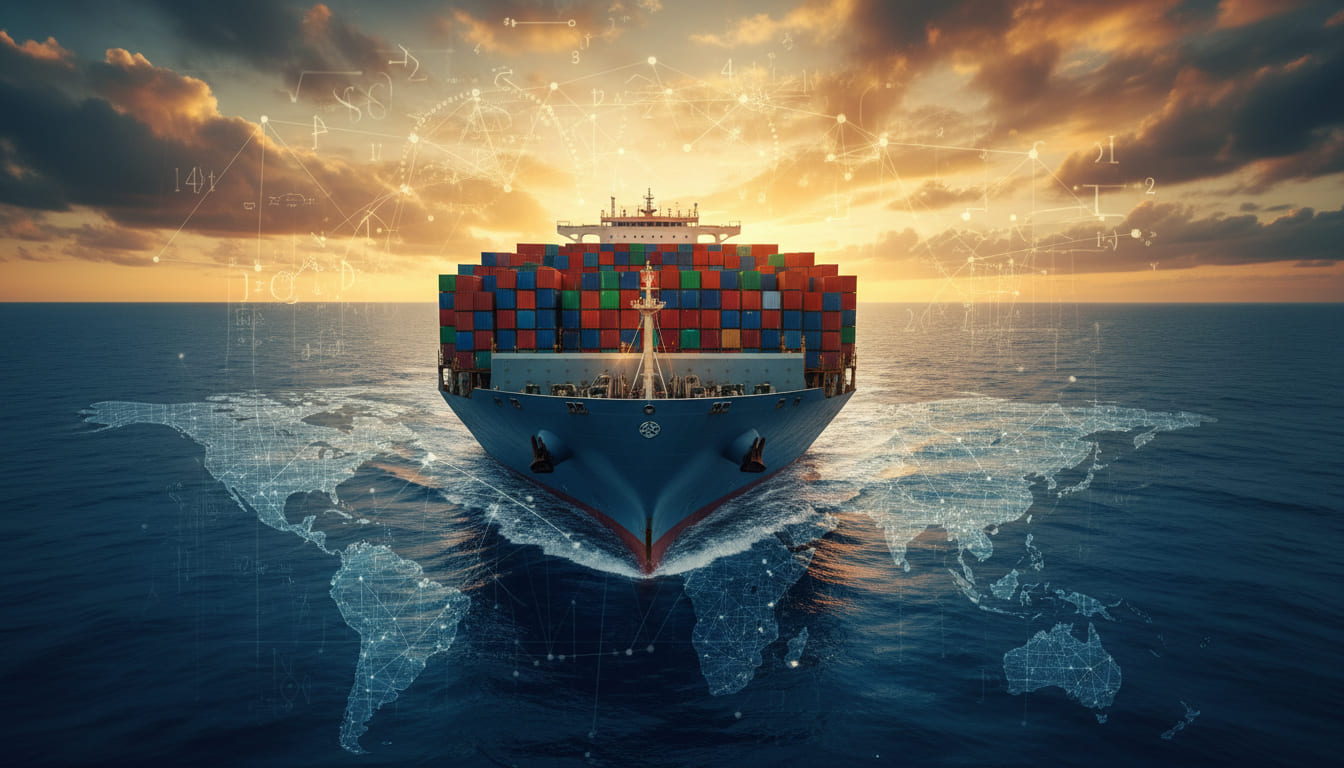
The Unseen Mathematics of Global Container Shipping
I vividly remember standing on the rain-slicked docks of the Port of Rotterdam in late 2019, watching a post-Panamax vessel meticulously unloaded by automated gantry cranes. The sheer scale of the operation felt less like a commercial enterprise and more like the circulatory system of the global economy. Every twenty-foot equivalent unit (TEU) swinging through the gray maritime sky represented a fragile node in an unimaginably complex mathematical equation. My job back then involved auditing demurrage fees for a mid-sized European importer of container shipping.
We were bleeding capital on terminal handling charges, and my analysis revealed a terrifying truth: modern maritime logistics rarely respects a spreadsheet. Fast forward to the present day. The rules governing how cargo moves from origin to destination have been fundamentally rewritten by volatility. Shippers no longer simply book a slot and wait for a bill of lading. They engage in high-stakes negotiations against oligopolistic alliances, battle structural port congestion, and navigate a maze of environmental regulations. Managing these variables requires a surgical understanding of the underlying mechanics. You cannot optimize what you do not truly comprehend.
Executive Summary: The Realities of Modern Freight
| Market Variable | Historical Norms | Current Operational Reality |
|---|---|---|
| Capacity Management | Fixed schedules with predictable seasonal peak volumes. | Aggressive blank sailings utilized to artificially manipulate spot rates. |
| Regulatory Compliance | Fragmented regional rules with lax enforcement mechanisms. | Strict global decarbonization mandates enforcing massive capital expenditure. |
| Sourcing Strategy | Heavily reliant on long-term fixed-rate contracts. | Dynamic allocation balancing index-linked contracts and spot market hedging. |
The Economics of Container Shipping
To grasp the financial turbulence of moving a metal box across an ocean, you must abandon the idea that ocean carriers are simply transportation providers. They are yield-management algorithms wrapped in steel. The bifurcation of the pricing environment is the most critical concept to master. During a sourcing audit last year for an electronics manufacturer, I noticed their procurement team treating ocean freight as a commoditized expense. They simply requested bids and chose the lowest denominator. That strategy disintegrated when capacity tightened. Carriers bypassed their low-yielding cargo, leaving their inventory stranded in Yantian.
Ocean freight economics operate on strict yield optimization. Carriers assess the profitability of a specific voyage not just by the base freight rate, but through a complex layering of accessorial charges. You have your Bunker Adjustment Factor (BAF) tied to fuel price volatility, your Currency Adjustment Factor (CAF) hedging against exchange rate fluctuations, and Terminal Handling Charges (THC) that vary wildly depending on the destination port’s infrastructure. When you aggregate these variables, the baseline cost of moving a TEU becomes a highly dynamic figure. If a shipper fails to understand the carrier’s margin structure, they will inevitably face rolled cargo. The carrier will always prioritize the highest-yielding box on the dock.
Spot Market Dynamics versus Contract Rates
Sourcing ocean capacity essentially forces you to choose between two competing philosophies: security and agility. The spot market is a brutal, unvarnished reflection of real-time supply and demand. It fluctuates with the capriciousness of day trading. I have witnessed trans-Pacific spot rates quadruple within a sixty-day window due to localized outbreaks shutting down single terminals in southern China. Relying entirely on the spot market exposes a supply chain to existential financial risk. Conversely, long-term contracts offer illusory stability. Shippers negotiate fixed rates, assuming their budgets are insulated. However, standardized contracts provided by BIMCO often dictate terms that heavily favor the vessel operator during black swan events.
When spot rates dramatically exceed contract rates, carriers suddenly discover operational necessities that require them to implement blank sailings—effectively canceling the voyage your contracted cargo was meant to load onto. They then redeploy that vessel to a more lucrative spot-heavy route. This practice, known as capacity management, infuriates shippers but is a perfectly legal mathematical optimization from the carrier’s perspective. Balancing these two markets requires sophisticated forecasting. You must allocate your baseload volume to staggered, index-linked contracts while keeping a strategic percentage of your freight on the spot market to capitalize on sudden rate depressions.
Navigating Global Freight and Ocean Freight Constraints
Physical infrastructure has not kept pace with vessel architecture. We are currently trying to squeeze twenty-four-thousand TEU ultra-large container vessels (ULCVs) into ports designed for ships half that size. The bottleneck is no longer strictly maritime; it is deeply terrestrial. Consider the cascading failures of a delayed berthing. A vessel arrives at the Port of Long Beach three days late due to severe Pacific weather. The terminal operator, having already allocated that berth to a subsequent ship, forces the delayed vessel to anchor offshore. The containers aboard that ship miss their scheduled rail connections. The chassis required to move those boxes out of the terminal remain trapped under empty containers that cannot be returned because the terminal is gridlocked. This specific constraint brings us to the most painful acronym in logistics: D&D (Demurrage and Detention).
Drayage and Terminal Congestion
Demurrage is the penalty charged when your imported container sits inside the port terminal beyond its allotted free time. Detention is the fee levied when you take the container out of the port but fail to return the empty equipment within the agreed window. These fees are punitively high, designed to force cargo velocity. However, what happens when a shipper cannot physically retrieve their box because there is a severe shortage of available chassis? Or when the terminal refuses empty returns because their stacks are dangerously high? I have sat across from clients staring at six-figure demurrage invoices generated entirely by systemic inefficiencies outside their control.
Mitigating this requires integrating your ocean strategy with your drayage capabilities. You cannot view the ocean voyage in isolation. Forward-thinking operators orchestrate the entire door-to-door movement. For instance, evaluating customized logistics via jkc cargo often yields immediate visibility improvements across complex trans-Pacific routes. By pre-booking drayage capacity simultaneously with the ocean booking, you eliminate the frantic scramble that typically occurs when the vessel crosses the geopolitical boundary of the destination port.
Regulatory Frameworks in Container Shipping Logistics
The maritime industry long operated in a nebulous regulatory environment, protected by international waters and complex flag-of-convenience registrations. That era has definitively ended. The push for environmental accountability has fundamentally altered the capital expenditure requirements of operating a vessel fleet. Under the latest International Maritime Organization frameworks, the industry is mandated to drastically reduce its greenhouse gas emissions. This is not a distant, theoretical target. It is impacting freight rates today. The implementation of IMO 2020, which capped the sulfur content of marine fuel at 0.5 percent, forced carriers into a massive financial dilemma. They had to either retrofit their existing fleets with expensive exhaust gas cleaning systems (scrubbers) or switch to significantly more expensive Very Low Sulfur Fuel Oil (VLSFO).
The Financial Burden of Decarbonization Mandates
The subsequent leap toward absolute decarbonization introduces the Carbon Intensity Indicator (CII) and the Energy Efficiency Existing Ship Index (EEXI). These operational rules grade vessels based on their efficiency. If a ship scores poorly, it faces operational restrictions. The most immediate compliance mechanism carriers deploy is slow steaming. By reducing a vessel’s speed by just a few knots, fuel consumption and emissions drop exponentially. The mathematical elegance of slow steaming is undeniable. However, the operational consequence is profound. Slower ships mean longer transit times.
To maintain weekly port calls on a specific string, carriers must inject additional vessels into that rotation. This absorbs global vessel capacity, artificially tightening supply and applying upward pressure on baseline freight rates. Shippers must recalibrate their inventory carrying costs. A supply chain designed around a twenty-one-day transit from Shanghai to Los Angeles will hemorrhage cash if that transit permanently extends to twenty-eight days due to environmental speed restrictions. You are effectively financing an extra week of floating inventory. The transition to alternative fuels—methanol, ammonia, and bio-LNG—will only exacerbate these costs. The infrastructure to bunker these fuels globally does not yet exist at scale, meaning the early adopters will pass the heavy premium of these boutique fuels directly to the shipper via specialized environmental surcharges.
Carrier Dynamics and Market Oligopolies
If you examine the competitive landscape of the maritime sector prior to 2016, you would find a fragmented market struggling with chronic overcapacity. Carriers regularly operated at a loss, cannibalizing each other in a race to the bottom for market share. A wave of bankruptcies and aggressive consolidations followed. Today, the global east-west trade lanes are utterly dominated by three major vessel-sharing agreements: 2M (currently winding down), the Ocean Alliance, and THE Alliance. This consolidation transformed a buyer’s market into a highly disciplined seller’s market. Data aggregated by the World Trade Organization illustrates how this shift in market power has dramatically altered the negotiation leverage of international traders. The alliances operate by pooling their fleets, allowing them to offer extensive global coverage without each carrier needing to deploy their own ship on every route.
Blank Sailings in Container Shipping Alliances
This pooling of resources allows for unprecedented capacity management. When demand softens, the alliance does not engage in a price war. Instead, they mutually agree to void specific scheduled voyages. This is the feared blank sailing. By artificially removing capacity from the water, they stabilize the spot rate environment. I recall a specific operational nightmare in 2022. I was managing the inbound logistics for a fast-fashion retailer. We had meticulously scheduled our production runs to match the weekly sailings of the Ocean Alliance.
Without warning, the alliance announced three consecutive blank sailings out of Ningbo due to a dip in European demand. Our cargo was rolled repeatedly. We were forced to charter expensive air freight to stock the shelves for a seasonal launch. Understanding carrier dynamics means recognizing that you are negotiating against a highly organized cartel structure. You must leverage your volume carefully. Distributing your freight across carriers in different alliances mitigates the risk of a single network failure cascading through your entire supply chain. It requires a forensic analysis of alliance schedules, terminal affiliations, and historical reliability metrics.
Advanced Capacity Management and Forecasting
The discipline of securing space on a vessel has transitioned from relationship-based booking to algorithmic forecasting. Carriers are actively penalizing shippers who exhibit poor forecasting accuracy. If you book one hundred TEUs but only deliver eighty to the terminal, you have created a ghost booking. Historically, shippers overbooked to guarantee space, knowing the carrier would eventually roll the excess. Today, carriers implement stringent no-show fees. If you fail to deliver the container against your booking, you are invoiced a dead freight penalty. Conversely, if you under-forecast, you are forced into the punitive spot market to cover the delta. The precision required demands integrated data architecture.
Transportation Management Systems (TMS) must ingest real-time sales data, manufacturing outputs, and supplier constraints to generate a dynamic volume forecast. I spent six months implementing an API-driven forecasting model for an automotive supplier. We linked their Tier 1 component suppliers directly to our carrier allocation algorithms. When a factory in Vietnam reported a production delay, the system automatically adjusted the ocean booking two weeks in advance, completely avoiding the dead freight penalty and reallocating that space to an alternative supplier in Thailand. This level of granularity is no longer optional; it is the baseline requirement for survival in a volatile maritime environment.
Risk Mitigation in Containerized Transport
The ocean is inherently hostile. The assumption that a sealed steel box guarantees the safety of its contents is a dangerous fallacy. From severe parametric rolling causing container stacks to collapse into the Pacific, to localized fires triggered by misdeclared hazardous materials, the physical risks are substantial. Yet, the financial risks embedded in maritime law are often far more devastating to the unprepared shipper.
Most importers operate under the mistaken belief that the carrier is fully liable for damaged or lost cargo. Under the Carriage of Goods by Sea Act (COGSA), a carrier’s liability is notoriously limited—often to a mere five hundred dollars per customary freight unit. If a container holding half a million dollars of high-end consumer electronics ends up at the bottom of the ocean, the un-insured shipper faces a catastrophic financial write-off. Comprehensive marine cargo insurance is the only firewall between a logistics failure and financial ruin.
The Peril of General Average Declarations
Beyond direct cargo loss, shippers must understand the archaic but actively utilized principle of General Average. This maritime law dictates that if a vessel master must intentionally sacrifice cargo or incur extraordinary expenses to save the ship and the remaining cargo, all parties involved in that voyage must proportionally share the financial loss. If you had cargo on the infamous vessel that lodged itself sideways in the Suez Canal, you became intimately familiar with this concept. When the shipowners declared General Average to cover the astronomical costs of the salvage operation, every single cargo owner with a box on that ship had to post a massive cash bond or a specialized insurance guarantee before the terminal would release their goods—even if their specific container was completely undamaged.
I fielded frantic calls from clients who had no idea what General Average was, suddenly facing demands for hundreds of thousands of dollars just to retrieve their own property. Proper marine insurance inherently covers General Average contributions. Operating without it is a gamble with ruinous odds. Risk mitigation also extends to the physical condition of the container itself. Reefer (refrigerated) containers are prone to genset failures. A minor fluctuation in temperature can decimate agricultural perishables or sensitive pharmaceuticals. Implementing independent, real-time IoT temperature loggers inside the container provides the irrefutable data necessary to process an insurance claim if the carrier’s equipment fails during the voyage.
Technological Shifts and Supply Chain Visibility
The maritime industry is notoriously archaic, often relying on physical paper bills of lading and fragmented email chains. However, a massive influx of venture capital has fueled a digitalization race. The goal is unbroken visibility. Traditional tracking relied on EDI (Electronic Data Interchange) milestone messages. These were often delayed, batched, or simply missing. You would receive a message that your container had been discharged, only to discover it was physically buried under five hundred other boxes and entirely inaccessible. The shift toward API integration offers real-time latency. Shipping lines, terminal operating systems, and customs authorities are slowly interconnecting their databases. We are entering the era of the smart container.
Embedded telematics provide not just location data, but internal telemetry: temperature, humidity, shock events, and door-opening sensors. When I worked with a high-value pharmaceuticals distributor, we mandated the use of active tracking devices. During a transit through the Red Sea, the telemetry flagged a sustained temperature spike in a reefer container carrying vaccines. We intercepted the container at the transshipment port in Dubai, validated the spoilage, and initiated the replacement production run weeks before the damaged goods ever reached the final destination. That proactive intervention saved the client a crucial distribution contract. Technology transforms a reactive supply chain into a proactive intelligence network.
Strategic Sourcing in Container Shipping Logistics
Mastering this environment requires a paradigm shift in procurement strategy. You cannot negotiate ocean freight as a standalone commodity. It must be integrated into a holistic supply chain architecture. This involves evaluating total landed cost rather than just the port-to-port freight rate. A cheaper base rate from a carrier with a notorious record for rolled cargo and high demurrage penalties will ultimately cost significantly more than a premium rate from a highly reliable operator. Furthermore, understanding the interplay between Non-Vessel Operating Common Carriers (NVOCCs) and direct carrier contracts is essential. NVOCCs purchase bulk space from the shipping lines and resell it to smaller shippers. While they add a margin, they provide critical flexibility.
During tight capacity crunches, a strong NVOCC often has more leverage to secure space than a mid-sized shipper negotiating directly with the vessel operator. The architecture of global trade relies heavily on the container. By dissecting the economics, navigating the constraints, and understanding the formidable regulatory landscape, logistics professionals can forge supply chains capable of withstanding the inherent chaos of the open ocean. It is a discipline of constant vigilance, mathematical precision, and an unwavering respect for the volatility of global maritime networks.