

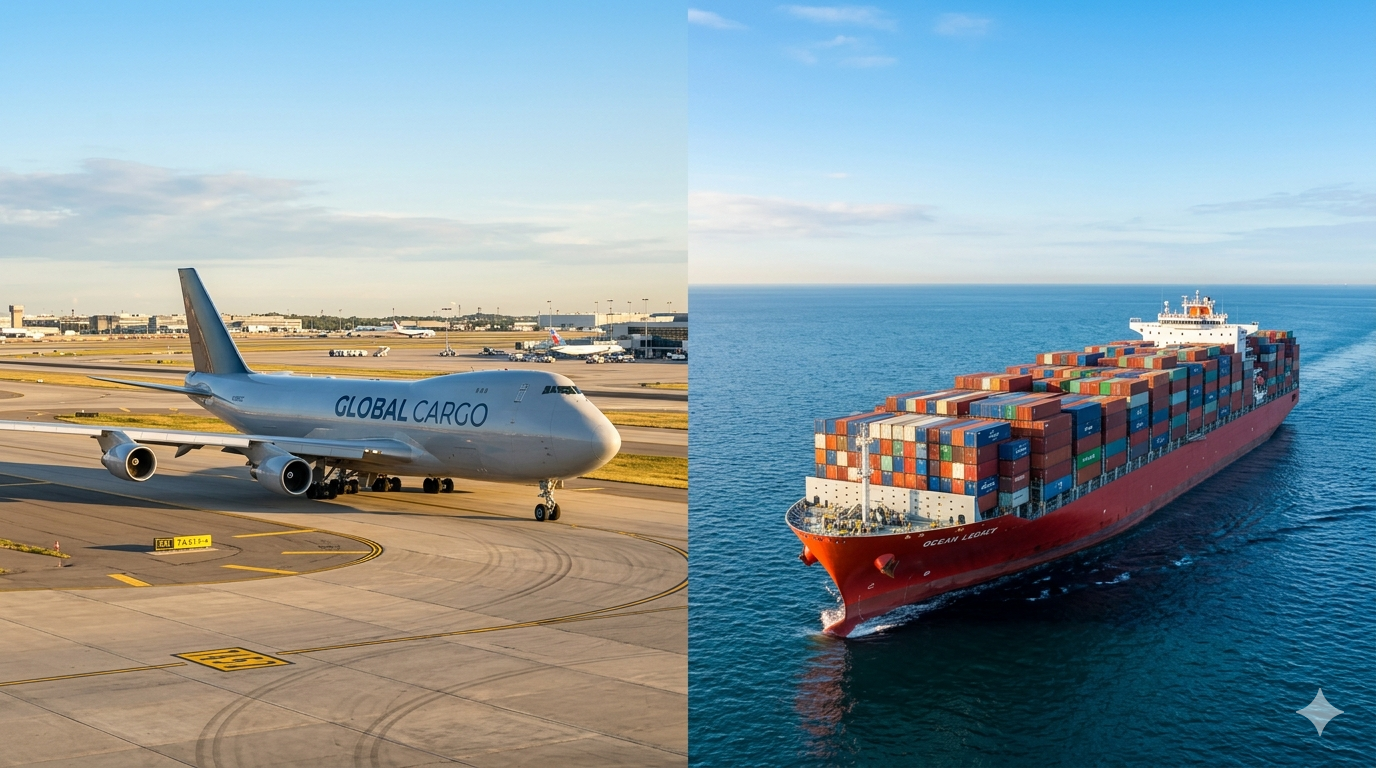
Air Cargo vs Sea Cargo | Which Shipping Method Is Best?
When you need to ship goods internationally, one of the first decisions you face is choosing between air cargo and sea cargo. Air Cargo vs Sea Cargo both methods have their own strengths, and the right choice depends on your specific needs, budget, and timeline.
Air cargo is fast, reliable, and ideal for time-sensitive shipments. Sea cargo, on the other hand, is cost-effective and handles large volumes with ease. However, making the wrong choice can cost you time, money, and customer satisfaction.
In today’s global trade environment, businesses need to think smart. Whether you are a small business owner shipping products overseas or a large company managing a complex supply chain, understanding the key differences between air and sea freight is essential.
Therefore, this article breaks down everything you need to know. We will compare both shipping methods across several important factors — including cost, speed, capacity, reliability, environmental impact, and more. In addition, we will help you decide which option suits your business best.
By the end of this guide, you will have a clear picture of when to choose air cargo and when sea cargo makes more sense. Moreover, you will learn how to make smarter shipping decisions that save money and improve delivery performance.
Let us dive in and explore both options in detail.
Understanding the Basics of Air Cargo and Sea Cargo
Before comparing the two [Air Cargo vs Sea Cargo], it helps to understand what each method actually involves.
Air cargo refers to the transportation of goods by aircraft. Airlines carry freight in the belly of passenger planes or in dedicated cargo planes. This method moves goods across the world within hours or a few days.
Sea cargo, also known as ocean freight, involves shipping goods in large containers loaded onto ships. These vessels travel across oceans and connect major ports around the world. Sea shipping takes longer but can carry massive volumes at a time.
Both methods [Air Cargo vs Sea Cargo] play a critical role in international trade. Therefore, choosing the right one requires a solid understanding of your shipment needs.
Speed: Air Cargo Wins Every Time
When it comes to speed, air cargo has a clear advantage. A shipment from Pakistan to the United Kingdom, for example, can arrive by air in just 1 to 5 days. The same shipment by sea could take anywhere from 20 to 40 days.
For time-sensitive goods, speed is everything. Businesses dealing in perishable items, urgent documents, medical supplies, or high-demand consumer products simply cannot afford long transit times.
Moreover, air cargo offers more predictable schedules. Flights depart regularly, and delays are less common compared to sea routes affected by weather or port congestion.
However, if your goods are not time-sensitive, the speed advantage of air freight may not justify its higher cost.
Cost: Sea Cargo Is Far More Affordable
Cost is one of the most significant factors in any shipping decision. In this area, sea cargo wins by a wide margin.
Shipping goods by sea is typically 4 to 6 times cheaper than air freight. The reason is simple ships carry enormous quantities of cargo in a single voyage, which spreads the cost across thousands of shipments.
For businesses shipping large volumes of goods, sea freight is the most economical choice. Therefore, industries like retail, manufacturing, and construction heavily rely on ocean freight to keep their supply chains running at low cost.
Air cargo, on the other hand, charges based on weight and volume. As a result, heavy or bulky shipments become extremely expensive when moved by air. A cost-benefit analysis is always recommended before making a decision.
Cargo Capacity: Sea Freight Handles More Volume
Sea cargo offers virtually unlimited capacity. A single container ship can carry thousands of 20-foot or 40-foot containers. This makes it perfect for bulk shipments, heavy machinery, vehicles, raw materials, and oversized goods.
Air cargo, in contrast, has significant size and weight restrictions. Aircraft cargo holds have limited dimensions, and oversize freight often cannot be accommodated at all.
In addition, sea freight offers flexible container options. You can choose Full Container Load (FCL) if you have a large shipment, or Less than Container Load (LCL) if you only need part of a container. This flexibility makes sea shipping suitable for businesses of all sizes.
Therefore, if your shipment is large, heavy, or bulky, sea freight is the only practical and affordable choice.
Reliability and Safety: Both Have Strengths
Reliability is a major concern for any business that depends on consistent delivery timelines.
Air cargo is generally more reliable in terms of schedule. Airlines follow tight timetables, and tracking systems provide real-time shipment updates. Delays do happen, but they are usually shorter and more manageable.
Sea cargo, however, faces more unpredictability. Weather conditions, port congestion, and mechanical issues can all cause delays. Moreover, sea routes are longer, which increases the window for potential disruptions.
That said, sea shipping is considered safe for most cargo types. Containers are sealed, stacked, and secured tightly on vessels. In addition, modern ships have sophisticated navigation and safety systems.
For fragile or high-value items, air cargo often provides better protection due to shorter transit time and less physical handling.
Environmental Impact: A Growing Concern
Sustainability is becoming a key factor in business decisions. In this regard, sea cargo has a much lower carbon footprint per unit of cargo compared to air freight.
Aircraft emit significantly more CO2 per kilogram of goods transported. Therefore, companies with strong environmental policies often prefer sea freight when time allows.
However, the shipping industry as a whole is working hard to become greener. Many major carriers are investing in fuel-efficient vessels, cleaner fuels, and carbon offset programs. Similarly, [Air Cargo vs Sea Cargo] airlines are introducing more fuel-efficient aircraft to reduce emissions.
For businesses looking to reduce their environmental impact, sea cargo is the more sustainable option in most cases.
Customs and Documentation: What You Should Expect
Both air and sea cargo require proper documentation and customs clearance. However, the process differs slightly between the two.
Air freight customs tend to be faster. Since goods arrive quickly, airport customs authorities process them with speed and efficiency. In most cases, your shipment can clear customs within 24 to 48 hours of arrival.
Sea freight customs, on the other hand, can take longer. Port procedures involve more paperwork, physical inspections, and container scanning. Therefore, businesses need to factor in customs clearance time when planning their sea shipments.
Working with an experienced freight forwarder can make the customs process much smoother for both methods. They understand the rules, documentation requirements, and local regulations at different ports and airports around the world.
Types of Goods Best Suited for Each Method
Not all goods are equal when it comes to shipping. Therefore, understanding which products work best with each method saves time and money.
Best suited for air cargo:
Perishable goods like food and pharmaceuticals, high-value electronics, fashion and luxury items, urgent spare parts, important documents and samples, and small but time-critical shipments all travel best by air.
Best suited for sea cargo:
Heavy machinery and industrial equipment, furniture and household goods, raw materials like steel, timber, and chemicals, automobiles and vehicles, and large retail inventory and bulk consumer goods all move more efficiently and affordably by sea.
In addition, dangerous goods and hazardous materials often have specific requirements under both methods, so always check regulations before booking.
Tracking and Visibility: Technology Makes It Easier
Modern logistics technology has improved tracking capabilities for both air and sea shipments significantly.
Air cargo tracking is generally more precise. Since flights are shorter and more frequent, updates are available in near real-time. Most airlines and air freight companies provide digital tracking portals.
Sea cargo tracking has also improved greatly. GPS systems, satellite communication, and port management software now allow businesses to monitor their container’s exact position at sea. However, updates may come less frequently compared to air shipments.
Therefore, if real-time visibility is critical for your operations, air cargo still holds the edge. However, sea freight tracking is reliable enough for most standard commercial shipments.
Risk of Damage and Loss: Key Considerations
Every business wants its goods to arrive in perfect condition. Therefore, understanding the risks associated with each method is important.
Air freight carries lower risk of damage. Goods spend less time in transit, face fewer handling touchpoints, and are not exposed to harsh sea conditions. This makes air shipping ideal for fragile, delicate, or high-value products.
Sea freight, while generally safe, does carry slightly higher risks. Containers can experience moisture, temperature changes, and rough seas during long ocean voyages. Moreover, LCL shipments are handled more frequently as they are consolidated with other goods, which increases the chance of minor damage.
Proper packaging and marine insurance can significantly reduce risk for sea shipments. Similarly, cargo insurance is advisable for air shipments involving high-value goods.
Insurance Costs: Plan Ahead
Insurance is an essential part of international shipping. Both air and sea cargo require cargo insurance, but the costs and coverage differ.
Air cargo insurance is typically lower in cost because the transit time is short and the risk of loss or damage is relatively low. However, premiums depend on the value and nature of the goods.
Sea cargo insurance tends to be slightly higher due to longer transit times and greater exposure to environmental risks. In addition, LCL shipments may require additional coverage because they are handled by multiple parties.
Working with a professional freight forwarder like JKC Cargo ensures that your shipment is properly insured and protected from port to destination.
When to Choose Air Cargo
Choose air freight when:
Your shipment is urgent and time is the top priority. The goods are high-value, fragile, or perishable. You are shipping small to medium-sized quantities. Your customers expect fast delivery. The destination requires quick market entry.
In addition, air cargo is often the right choice for businesses launching new products, fulfilling last-minute orders, or managing peak-season demand spikes.
When to Choose Sea Cargo
Choose sea freight when:
Your shipment is large, heavy, or oversized. Cost savings are more important than speed. You have enough lead time to plan shipments in advance. You are shipping raw materials or bulk goods.
Moreover, sea cargo is the foundation of global trade for a reason. It handles the majority of the world’s goods and remains the most practical solution for high-volume, long-distance shipping.
Combining Both: The Multimodal Approach
Many businesses today use a combination of air and sea cargo depending on the shipment type and urgency. This is known as multimodal or intermodal shipping.
For example, [Air Cargo vs Sea Cargo] a company might ship most of its inventory by sea to save costs, while using air freight for urgent restocking or special orders. Therefore, having a flexible logistics strategy that uses both methods gives businesses a competitive advantage.
Working with a reliable freight partner like JKC Cargo allows you to access both air and sea freight solutions under one roof. Moreover, an experienced team can help you decide the best method for each shipment saving you both time and money.
How to Choose the Right Freight Partner
Choosing the right freight forwarder is just as important as choosing the right shipping method.
A good freight partner will understand your business needs, offer competitive rates, handle documentation and customs efficiently, and provide transparent tracking throughout the journey.
In addition, they will offer expert advice on packaging, insurance, import/export regulations, and the most cost-effective routing options.
If you are shipping goods from Pakistan or looking for reliable international shipping services, explore the air and sea freight solutions at JKC Cargo to get started with a trusted logistics partner.
Final Cost Comparison: A Quick Overview
Here is a simple comparison to summarize the cost differences:
Air Cargo: Higher per-kilogram cost, fast transit, low volume, suitable for urgent and high-value goods.
Sea Cargo: Lower per-unit cost, slow transit, high volume, suitable for bulk and non-urgent goods.
Therefore, the real question is not which method is better overall it is which method is better for your specific shipment. With the right information and the right partner, you can make smart shipping decisions every time.
For more detailed information on international freight regulations and industry standards, you can refer to the International Air Transport Association (IATA) a trusted authority on global air cargo guidelines and best practices.
Conclusion
Choosing between air cargo and sea cargo is not a one-size-fits-all decision. Both methods serve important roles in global trade, and the best choice always depends on your specific shipping needs.
Air cargo is the right choice when speed, security, and reliability matter most. It is ideal for time-sensitive, high-value, or perishable goods. However, it comes at a higher cost and is better suited for smaller shipments.
Sea cargo, on the other hand, is the backbone of international trade. It offers unmatched capacity, significantly lower costs, and is the most practical solution for bulk or heavy shipments. Therefore, if you have flexibility in your timeline, sea freight almost always delivers better value for money.
Moreover, the smartest businesses do not limit themselves to just one method. They build flexible logistics strategies that combine both air and sea freight depending on the shipment type, urgency, and budget. This approach keeps supply chains efficient and cost-effective throughout the year.
In addition, working with the right freight partner makes all the difference. A reliable and experienced team helps you navigate customs, documentation, insurance, and routing so your goods arrive safely and on time, every time.
Whether you need fast air freight or affordable sea cargo solutions, JKC Cargo is here to help. Explore our full range of international shipping services and get a quote today. Let us take the complexity out of global shipping so you can focus on growing your business.
Frequently Asked Questions (FAQs)
Q1. What is the main difference between air cargo and sea cargo?
The main difference lies in speed and cost. Air cargo is significantly faster, typically delivering goods within 1 to 5 days, but it is more expensive. Sea cargo takes longer usually 20 to 40 days but it is far more affordable, especially for large or heavy shipments. Therefore, the right choice depends on your timeline and budget.
Q2. Which shipping method is better for small businesses?
It depends on the type of goods and urgency. Small businesses shipping high-value or time-sensitive products often benefit more from air cargo. However, if a small business is importing large quantities of inventory and has enough lead time, sea cargo is the more cost-effective option. In addition, LCL (Less than Container Load) sea freight allows small businesses to share container space and reduce costs further.
Q3. Is air cargo safer than sea cargo for fragile goods?
Generally, yes. Air cargo involves shorter transit times and fewer handling touchpoints, which reduces the risk of damage for fragile or delicate items. Sea cargo, while reliable, exposes goods to longer transit conditions including moisture, temperature changes, and rough seas. Therefore, for fragile or high-value goods, air freight is usually the safer and more recommended choice.
Based on your business details, the physical office for JKC Cargo is located at Sajid Plaza in Mirpur, Azad Jammu and Kashmir.
Contact us via contact page :-https://jkccargo.com/contact/
Direct call us :- 0300 9535077
Mail address; jkcargo@gmail.com / info@jkccargo.com