

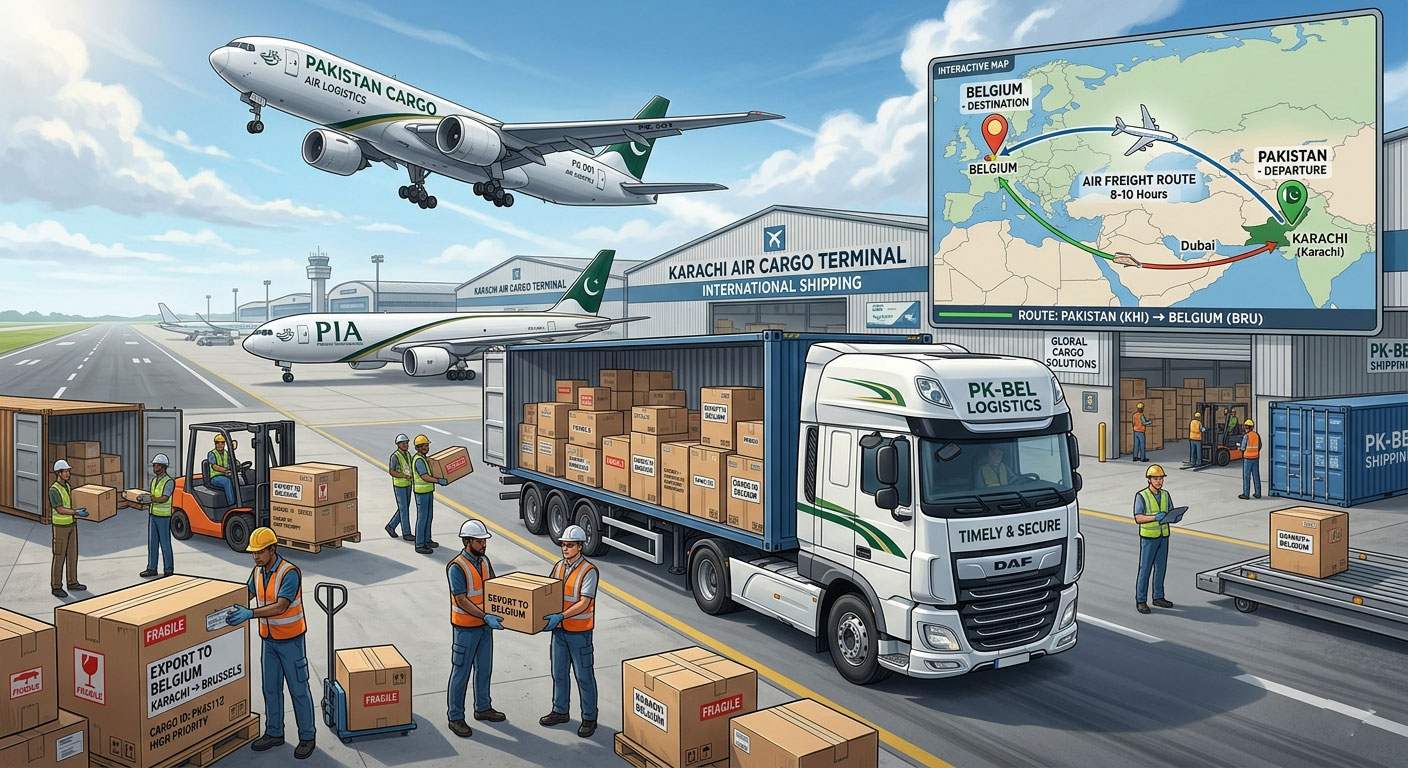
Pakistan to Belgium Cargo Services – Secure & Timely Delivery
Are you looking to send goods from Pakistan to the heart of Europe? Whether it’s a cherished gift for a loved one, essential business inventory, or your entire household as you embark on a new adventure, the journey of your cargo across continents can feel like a daunting task. The good news is, it doesn’t have to be. With the right partner, navigating the complexities of international shipping becomes a smooth, predictable, and even enjoyable experience. This comprehensive guide is designed to empower you with the knowledge and confidence you need to ensure your Pakistan to Belgium cargo arrives safely, on time, and without a hitch
Sending Cargo from Pakistan to Belgium? Here’s What You Need to Know!
Welcome to your go-to guide for shipping from Pakistan to Belgium. In an increasingly connected world, the demand for reliable international cargo services has never been higher.
Understanding this growing need, we’ve seen countless individuals and businesses grapple with the intricacies of cross-border logistics. From choosing the right shipping method to understanding customs regulations, there are many moving parts. This is precisely why choosing the right service provider is not just a convenience; it’s crucial for your peace of mind and the successful delivery of your goods. A seasoned logistics partner acts as your guide, simplifying the process and ensuring every detail is meticulously handled.
Why Trust Experts for Your Pakistan to Belgium Cargo Journey?
Navigating the waters (or skies!) of international shipping can be incredibly complex.
The benefits of entrusting your Pakistan to Belgium cargo services to experts are manifold. Firstly, there’s the undeniable gain in efficiency. An experienced team knows the fastest routes, the most reliable carriers, and the optimal times for shipping, minimizing transit times and ensuring your goods reach their destination without unnecessary delays. Secondly, safety is paramount. Professional cargo companies employ robust packaging standards, secure warehousing, and careful handling protocols to protect your valuable items from damage or loss throughout their journey. Finally, and perhaps most critically, compliance with international and local shipping laws is meticulously managed. This means avoiding costly penalties, unexpected hold-ups, or even the seizure of your goods due to incorrect documentation or adherence to import/export regulations.
Choosing Your Path: Air Freight vs. Sea Freight for Pakistan to Belgium Shipments
When planning your Pakistan to Belgium cargo shipment, one of the most fundamental decisions you’ll make is choosing between air freight and sea freight. Each option offers distinct advantages and disadvantages, making one more suitable than the other depending on your specific needs, budget, and timeline. Let’s break down these two primary methods.
Air Freight: Ideal for Urgent, High-Value, or Time-Sensitive Deliveries
Air freight is the undisputed champion when speed is your top priority. If you have urgent documents, high-value electronics, perishable goods, or time-critical samples that need to reach Belgium quickly, air freight is likely your best bet.
- Pros:
- Speed: This is the defining advantage. Cargo typically reaches Belgium in a matter of days (often 3-7 days, depending on specific services and customs).
- Higher Security: Airports and air cargo handling facilities generally have stringent security measures, offering an added layer of protection for your goods.
- Wider Reach: Air cargo can reach various airports across Belgium (e.g., Brussels, Liège), offering flexibility for final delivery.
- Reliability: Air cargo schedules are often more consistent and less prone to weather-related delays compared to sea freight.
- Cons:
- Higher Cost: Air freight is significantly more expensive than sea freight, especially for heavier or bulkier items. Costs are typically calculated by weight or volumetric weight, whichever is greater.
- Weight and Size Restrictions: Airlines have stricter limitations on the size and weight of individual packages, though specialized cargo planes can handle larger items.
- Carbon Footprint: For environmentally conscious shippers, air freight has a higher carbon footprint per unit of cargo compared to sea freight.
- Typical items: Important documents, samples, e-commerce goods, fashion items, pharmaceuticals, small machinery parts, perishable items (e.g., certain foods, flowers), and any goods where time is of the essence.
Sea Freight: The Cost-Effective Solution for Bulkier or Less Urgent Cargo
For shipments where cost-effectiveness and volume are key, sea freight is the go-to option. It’s the backbone of global trade, carrying the vast majority of goods around the world.
Pros:
- Significantly Lower Cost: Especially for large volumes and heavy items, sea freight offers a much more economical solution.
- Suitable for Large Volumes and Heavy Items: Ships can transport virtually any size or weight of cargo, from a single pallet to multiple containers. You can opt for Full Container Load (FCL) if you have enough goods to fill a container, or Less than Container Load (LCL) if you’re sharing container space with other shippers.
- Less Restrictive on Size: Ideal for oversized items, vehicles, or industrial machinery that simply wouldn’t fit on an airplane.
- Lower Environmental Impact: Generally considered more eco-friendly per ton-mile than air freight.
Cons:
- Slower Transit Times: This is the main trade-off. Sea freight from Pakistan to Belgium can take anywhere from 25 to 45 days, sometimes longer, depending on the port, route, and potential transshipments.
- Potential for Longer Customs Clearance: Due to the volume of goods arriving by sea, customs clearance can sometimes take longer at ports compared to airports.
- Less Frequent Departures: While major shipping lanes have regular schedules, the frequency might be less than air cargo from specific origins.
- Typical items: Household goods (furniture, appliances), vehicles (cars, motorcycles), industrial machinery, raw materials, bulk commodities, non-perishable consumer goods, textiles, and any items where transit time is not critically urgent.
Understanding transit times, costs, and suitability for your specific Pakistan to Belgium cargo is vital. We’ll consider your budget, the urgency of your delivery, and the nature of your goods to recommend the perfect path for your cargo.
The Journey of Your Cargo: Step-by-Step Guide & Key Considerations
Once you’ve decided on air or sea freight, what happens next? The journey of your Pakistan to Belgium cargo involves several critical stages, each requiring meticulous attention to detail. Here’s a step-by-step breakdown of how professional services manage your shipment, along with key considerations to ensure a smooth process.
Initial Consultation & Quote
The first step is always a conversation. This initial discussion is crucial for setting expectations and identifying any unique challenges or opportunities for your shipment. We’ll also ask about the nature of your items – are they fragile, hazardous, or require special handling? This helps us tailor the perfect solution.
Documentation Demystified
Paperwork is often the most intimidating part of international shipping, but with expert guidance, it becomes manageable. Proper documentation is paramount for both Pakistani export procedures and Belgian import regulations. Missing or incorrect documents can lead to significant delays, fines, or even the rejection of your shipment.
- Commercial Invoice: This is a detailed record of the transaction between the exporter and importer. It includes information like the seller and buyer, description of goods, quantity, unit price, total value, and terms of sale (Incoterms). For personal effects, a Proforma Invoice or a detailed packing list with declared values is often used.
- Packing List: This document provides a comprehensive inventory of all items in the shipment, including their dimensions, weight, and how they are packed (e.g., number of boxes, pallets). It’s essential for customs inspection and cargo handling.
- Bill of Lading (for sea freight) / Air Waybill (for air freight): These are the contracts between the shipper and the carrier, acting as a receipt for the goods and a document of title (for Bill of Lading). They contain details of the goods, origin, destination, and terms of carriage.
- Certificates of Origin: Depending on the goods, a Certificate of Origin might be required to confirm where the goods were manufactured. This can sometimes influence duties and tariffs.
- Licenses and Permits: Certain goods, such as electronics, specific chemicals, or even some textiles, may require special export licenses from Pakistan or import permits for entry into Belgium. Our team will guide you on these specific requirements. For instance, shipping certain types of machinery might require an import license from the Belgian Federal Public Service Economy.
Expert Packaging & Labeling
The journey from Pakistan to Belgium can be long and sometimes bumpy. Proper packaging is your cargo’s first line of defense against damage. Our seasoned advice often emphasizes using high-quality, durable materials suitable for international travel. This means sturdy cartons, appropriate cushioning (bubble wrap, foam, packing peanuts), and, for larger items, crating or palletizing. We ensure your items are securely packed to withstand vibrations, impacts, and potential climate changes. Correct labeling is equally important, including clear recipient and sender information, tracking numbers, and any special handling instructions (e.g., “Fragile,” “This Side Up”). This precision minimizes the risk of misdirection or damage.
Customs Clearance & Duties
Navigating customs regulations at both the Pakistani export and Belgian import ends is a critical step that often causes anxiety. Belgium, as a member of the European Union, adheres to EU customs regulations, which are comprehensive and strictly enforced.
- Understanding Belgian Import Duties, Taxes, and Prohibited Items: All goods entering Belgium are subject to customs clearance. This involves assessing applicable duties, Value Added Tax (VAT), and excise duties, based on the type of goods, their value, and origin. For example, certain agricultural products or luxury items might incur higher duties. It’s crucial to be aware of prohibited and restricted items, such as certain types of weapons, drugs, or counterfeit goods, which will be confiscated. Even seemingly innocuous items like certain plants or food products can be restricted without proper phytosanitary certificates.
- Compliance with International Shipping Laws: Beyond duties, there’s compliance with various international treaties and national laws regarding safety, environmental standards, and product quality. A professional cargo service ensures all declarations are accurate and complete, preventing delays or fines. Our team stays updated on the latest changes in customs laws, providing field-tested advice to ensure your shipment sails through customs. We handle the submission of necessary declarations and liaise directly with customs officials on your behalf, resolving any queries swiftly.
Tracking Your Shipment
Once your cargo is on its way, peace of mind comes from knowing exactly where it is. Professional services offer advanced tracking systems, providing real-time updates from the moment your cargo leaves Pakistan until it reaches its final destination in Belgium. You’ll receive a dedicated tracking number, allowing you to monitor its progress online, often with detailed milestones like “Departed Port,” “Arrived at Customs,” and “Out for Delivery.” This transparency keeps you informed every step of the way
Ensuring Peace of Mind: Security, Tracking, and Customer Support for Your Cargo
When you entrust your valuable goods to an international cargo service, you’re not just looking for transportation; you’re seeking assurance. The journey from Pakistan to Belgium is significant, and ensuring the safety, visibility, and support for your cargo is paramount. This is where a top-tier service truly distinguishes itself, offering comprehensive solutions that guarantee your peace of mind.
5 FAQs
Q1: How long does cargo delivery from Pakistan to Belgium take?
A: Air shipments usually take 5–10 days, while sea shipments take 25–35 days depending on customs and logistics.
Q2: What types of shipments can I send to Belgium?
A: We handle documents, parcels, commercial goods, household items, and fragile shipments with full safety measures.
Q3: How is the shipping cost calculated?
A: Costs depend on cargo weight, dimensions, shipping method (air or sea), and additional services like door-to-door delivery or insurance.
Q4: Can I track my shipment to Belgium?
A: Yes! Real-time tracking is available for every shipment from pick-up in Pakistan to delivery in Belgium.
Q5: Do you handle customs clearance in Belgium?
A: Absolutely. Our experienced team manages all customs documentation and procedures for smooth, hassle-free delivery.
Conclusion
Choosing our Pakistan to Belgium cargo services ensures secure, timely, and affordable international shipping. Whether you need air or sea freight, door-to-door delivery, or customs clearance, we provide professional solutions with real-time tracking and customer support. Trust us to safely transport your cargo from Pakistan to Belgium every time.
Want to know more about our Cargo Service? Check out our Blog for tips, updates, and everything you need to ship safely and quickly! Or Contact Us.